Pilatus or Rigi? Lake-and-Mountain Round Trips from Lucerne
The great pleasure of Lake Lucerne is that you do not have to choose between water and mountains. Several peaks rise straight from its shores, and the classic day out combines the two: a boat across the lake, a railway or cableway up a mountain, and a different way back down. The two most famous are Pilatus and Rigi, and choosing between them is one of the most common questions visitors to Lucerne ask.
This guide compares the two round trips — how they work, what they involve, when they run and who they suit — and looks at two smaller alternatives, the Bürgenstock and the Stanserhorn, for days when you want something shorter.
Pilatus and Rigi at a glance
| Pilatus | Rigi | |
|---|---|---|
| The railway | The world’s steepest cogwheel railway, opened in 1889 | The Vitznau–Rigi Kulm rack railway, described as Europe’s first mountain railway |
| Gradient | Up to 48%, averaging 38% | — |
| Ride time | 27 minutes up, 33 minutes down | About 30 minutes |
| Season | May to November (cogwheel railway) | Check the operator’s timetable |
| The lake part | The boat back from Alpnachstad to Lucerne | The boat from Lucerne to Vitznau (about 55 minutes) |
| Character | Dramatic, rocky summit area at 2,132 m | Broad, grassy summit with wide views over the lake |
Pilatus
The railway
The Pilatus cogwheel railway is famous for one thing: it is the steepest cogwheel railway in the world. Opened in 1889, it climbs at gradients of up to 48%, averaging 38%, over 4,618 metres of track, rising 1,635 metres from Alpnachstad to Pilatus Kulm. The journey takes 27 minutes up and 33 minutes down. When the line opened, eleven steam railcars made the same climb in 70 to 80 minutes.
The railway runs from May to November, so the classic round trip is a warm-season outing.
The round trip
The Pilatus round trip with the boat from Lucerne takes about 4.5 hours. You travel by bus and panorama gondola up Pilatus, come down the world’s steepest cogwheel railway to Alpnachstad, and cross the lake back to Lucerne by boat. It is the classic “lake and mountain” day in a single loop: city, gondola, summit, cogwheel railway, boat.
At the top, the summit area at 2,132 metres looks out over Lake Lucerne and the Swiss Alps.
Who Pilatus suits
Pilatus suits visitors who want drama: a steep, rocky summit, a railway that seems to defy gravity, and a round trip that uses three different kinds of transport. Because the cogwheel railway runs only from May to November, it is a spring-to-autumn choice for the full loop.
Rigi
The railway
Rigi, known as the Queen of the Mountains, is reached from the lake by the Vitznau–Rigi Kulm rack railway, described as the first mountain railway in Europe. It takes about 30 minutes from Vitznau to Rigi Kulm.
The round trip
The classic Rigi round trip from Lucerne begins with a boat from Lucerne to Vitznau — about 55 minutes, on historic steamers in summer — and continues by rack railway up Rigi. It can be a half or full day, depending on how long you spend on the mountain.
Rigi’s summit is broad and open, with wide views over the lake and the surrounding country. It is a gentler mountain than Pilatus, with more space to wander.
Who Rigi suits
Rigi suits visitors who want a relaxed mountain day with a long boat trip, open views and room to walk. It is also a good choice outside the Pilatus railway’s May-to-November season; check the Rigi operator’s timetable for your date.
Two historic railways
Part of the appeal of both mountains is their history. These are not modern lifts built for tourists, but pioneering railways from the golden age of Swiss mountain travel.
The Pilatus railway opened in 1889. In its early years, eleven steam railcars worked the line, climbing the 4,618-metre track to Pilatus Kulm in 70 to 80 minutes. Today the journey takes 27 minutes up, but the route, cut into the rock along the mountain’s steep faces at gradients of up to 48%, is the same line that made it famous.
The Vitznau–Rigi Kulm railway is described as the first mountain railway in Europe, and riding it is a small piece of railway history. Combined with a crossing on one of the lake’s historic paddle steamers — which sail on the Vitznau route in summer — a Rigi day can feel like a trip back in time.
Getting to the start
For Pilatus
The Pilatus round trip starts in Lucerne itself. You take a bus from Lucerne to the valley station of the panorama gondola, ride the gondola and cable car up the mountain, and return via the cogwheel railway and the boat. Because the loop begins and ends in the city, there is no need to plan transport at either end.
For Rigi
The Rigi day starts at the lake piers in central Lucerne, with the boat to Vitznau (about 55 minutes) — or to Weggis (about 45 minutes), another gateway to the mountain. At Vitznau, the rack railway station is by the pier.
Pilatus or Rigi: how to choose
- For the most spectacular railway: Pilatus, with the world’s steepest cogwheel line.
- For a longer boat trip: Rigi, with the boat to Vitznau.
- For a dramatic, rocky summit: Pilatus.
- For a broad summit and gentle walks: Rigi.
- For a complete loop with three kinds of transport: Pilatus.
- For a visit outside May to November: Rigi (check the timetable).
- For history: both — Pilatus’s railway opened in 1889, and Rigi’s is described as Europe’s first mountain railway.
If you have two days, do both. They are very different experiences, and together they show two sides of the mountains around the lake.
Which suits whom
- First-time visitors with one day: Pilatus in season, for the full loop and the famous railway; Rigi otherwise.
- Families with young children: the Bürgenstock for a short outing, or Rigi for space to run on the summit.
- Railway enthusiasts: both — the world’s steepest cogwheel railway and Europe’s first mountain railway.
- Walkers: Rigi, with its broad summit and gentler terrain.
- Photographers: Pilatus for drama, Rigi for the lake views.
The Bürgenstock
For a shorter outing, the Bürgenstock is the easiest mountain excursion from Lucerne. The trip goes across the lake by catamaran, then up the funicular to the Bürgenstock resort, where the Hammetschwand lift — the highest free-standing outdoor lift in Europe — adds a final flourish. It is a flexible day ticket, and it suits visitors who want mountain views without a full day on a summit.
The Stanserhorn
The Stanserhorn, at 1,851 metres, is another lake excursion in the area, and a quieter alternative to the two famous peaks.
Costs and passes
Mountain excursions around Lake Lucerne are not cheap, but travel passes help:
- The scheduled boats accept the Swiss Travel Pass, the Swiss Travel Pass Flex, the GA, the Lake Lucerne Pass, the Tell-Pass, the half-fare card and Interrail and Eurail passes.
- For the mountain railways and cableways, check the operator’s terms for your pass before buying; coverage and discounts vary.
- Packaged round trips — such as the Pilatus round trip with the boat — combine several tickets and save queuing.
Combining a mountain with the city
Both round trips begin and end in Lucerne, which makes it easy to combine a mountain with the city.
- A Pilatus morning (about 4.5 hours) leaves the afternoon free for Lucerne’s old town and waterfront.
- A Rigi half day can be followed by an evening on the lake, or a short discovery cruise.
- A Bürgenstock outing is flexible enough to fit around almost any plan.
Accessibility
- The boats are the easiest part of any round trip: you board from the city piers.
- The Pilatus cogwheel railway and the gondola take you to the summit area without climbing, but the terrain at the top is mountainous.
- The Rigi railway delivers you to Rigi Kulm; the broad summit area has space to move around.
- The Bürgenstock funicular and the Hammetschwand lift are among the easiest ways to reach a high viewpoint.
Check with each operator about step-free access on specific vehicles and stations before you travel.
Mistakes to avoid
- Planning the Pilatus loop outside May to November. The cogwheel railway runs only in that season.
- Going up in cloud. Both mountains are about the view; check the webcams first.
- Dressing for the city. The summits are far cooler and windier than Lucerne.
- Rushing both mountains into one day. Each deserves at least half a day.
- Forgetting your pass. The scheduled boats accept the major Swiss passes.
Guided and ticketed options
The tours page lists several ways to do these trips:
- Pilatus round trip with the boat: bus and panorama gondola up, the steepest cogwheel railway down to Alpnachstad, and the boat back to Lucerne, in about 4.5 hours. The summit at 2,132 m, the steepest cogwheel railway and a lake crossing back to Lucerne.
- Classic Rigi round trip: the boat from Lucerne to Vitznau — historic steamers in summer — and the rack railway up Rigi, as a half or full day.
- Bürgenstock by boat and funicular: a catamaran crossing, the funicular railway and the Hammetschwand lift, as a flexible day ticket.
If you hold a Swiss Travel Pass or the GA, check how it applies to each mountain before you buy; the scheduled boats accept both.
Getting back
The round trips are designed so you do not retrace your steps.
- On the Pilatus loop, you come down the cogwheel railway to Alpnachstad and take the boat back across the lake to Lucerne — no backtracking at all.
- On Rigi, the simplest return is the railway back down to Vitznau and the boat to Lucerne; check the operator’s timetable for other ways down the mountain.
- From the Bürgenstock, the funicular takes you back down to the catamaran for the crossing to Lucerne.
Whichever you choose, check the last boat back to Lucerne before you settle in at the top.
Planning the day
A Pilatus day (May to November)
- Morning: from Lucerne, the bus and panorama gondola up Pilatus.
- Midday: the summit area at 2,132 m, with views over the lake and the Alps.
- Early afternoon: down the cogwheel railway to Alpnachstad — 33 minutes of steep descent.
- Afternoon: the boat back across the lake to Lucerne.
A Rigi day
- Morning: the boat from Lucerne to Vitznau (about 55 minutes).
- Late morning: the rack railway to Rigi Kulm (about 30 minutes).
- Midday and afternoon: walks and views on the summit.
- Late afternoon: down to Vitznau and the boat back to Lucerne.
A two-day plan
If you have two days in Lucerne, give each mountain its own day and let the weather decide the order.
Day one — whichever mountain has the clearer forecast. If it is Pilatus (and the season is May to November), take the round trip: bus and gondola up, cogwheel railway down to Alpnachstad, boat back. If it is Rigi, take the boat to Vitznau and the rack railway to Rigi Kulm.
Day two — the other one. Do the second round trip, and finish with a short evening cruise from Lucerne.
With a spare half day, add the Bürgenstock, whose catamaran crossing, funicular and Hammetschwand lift make a compact outing.
Photographs from the summits
- From Pilatus Kulm, the view down onto Lake Lucerne and across the Swiss Alps.
- From the cogwheel railway, the steepness of the line itself, cut into the mountainside.
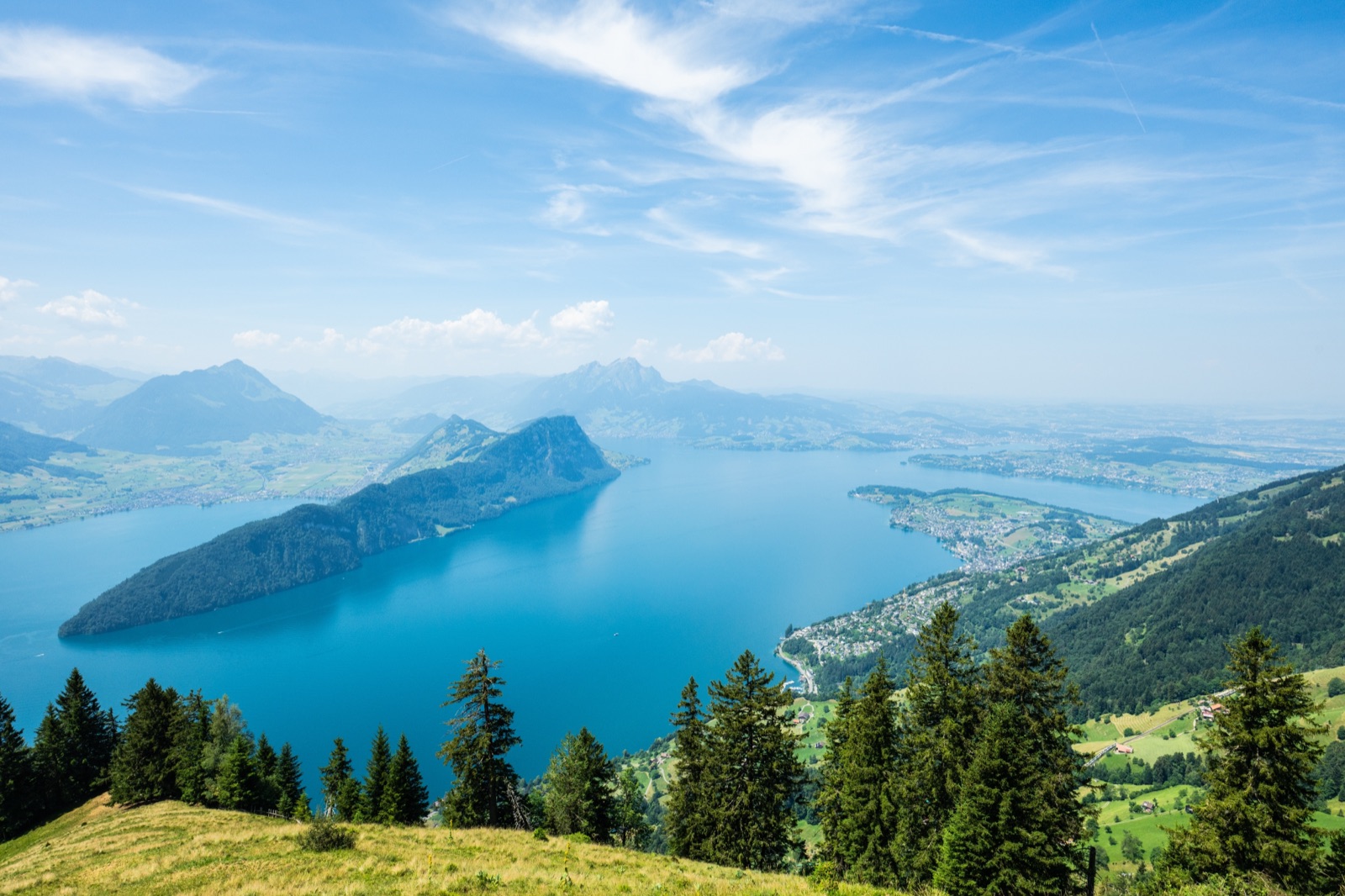
- From Rigi Kulm, the arms of the lake spreading out below.
- From the boat, the mountains rising straight from the water as you approach Vitznau or Alpnachstad.
If you can see the summits clearly from Lucerne, that is the day to go.
Weather and the view
Both mountains are about the view, and both depend on the weather. A clear day is worth planning around:
- Check the forecast and the webcams before you set off.
- Keep your mountain day flexible if you are in Lucerne for several days.
- If the peaks are in cloud, a boat trip on the lake is still beautiful, and the Bürgenstock is a shorter, lower alternative.
What to bring
- A warm layer. Pilatus Kulm at 2,132 m and Rigi Kulm are far cooler than Lucerne.
- Sun protection. The sun is strong at altitude.
- Good shoes for walking on the summits.
- Your travel pass, if you have one.
With children
Both round trips are excellent with children. The Pilatus cogwheel railway’s steepness is thrilling, and the gondola and boat add variety. Rigi’s broad summit gives children space to run. For younger children, the Bürgenstock is shorter and easier, and the Hammetschwand lift is an adventure in itself.
Frequently asked questions
Which is better, Pilatus or Rigi?
Pilatus for drama — the world’s steepest cogwheel railway and a rocky summit at 2,132 m. Rigi for a gentler day with a longer boat trip, a broad summit and Europe’s first mountain railway. If you have two days, do both.
When does the Pilatus cogwheel railway run?
From May to November. It takes 27 minutes up and 33 minutes down, at gradients of up to 48%.
How long is the Rigi railway from Vitznau?
About 30 minutes to Rigi Kulm. The boat from Lucerne to Vitznau takes about 55 minutes.
How long does the Pilatus round trip take?
About 4.5 hours from Lucerne: bus and panorama gondola up, the cogwheel railway down to Alpnachstad, and the boat back.
What is the Hammetschwand lift?
The highest free-standing outdoor lift in Europe, at the Bürgenstock, reached from Lucerne by catamaran and funicular.
Can I do Pilatus and Rigi in one day?
It is possible but rushed. Each round trip deserves at least half a day; with two days, do one each.
Is the Pilatus round trip possible in winter?
Not the classic loop, because the cogwheel railway runs from May to November. Outside that season, consider Rigi or the Bürgenstock, and check each operator’s winter timetable.
Do I need to book the Pilatus round trip in advance?
It is not always necessary, but booking the packaged round trip combines the gondola, cogwheel railway and boat in one ticket and saves queuing on busy days.