Places
Things to Do in Lake Lucerne: The City, the Villages and Lake Uri
The best things to do on and around Lake Lucerne fall into five groups: the old town of Lucerne itself (the Chapel Bridge, the Lion Monument and the Musegg Wall), the Swiss Museum of Transport on the lakeshore, a boat to one of the lake villages, a trip into Lake Uri for the Rütli meadow and Tell’s Chapel, and a mountain. In summer, add a swim: Lucerne has sandy lidos a short walk or bus ride from the station.
Many of them connect by boat, so a good plan is to pick one or two per day rather than trying to see everything. This guide takes them from the city outwards, with what each involves, how long it takes and the seasonal catches worth knowing before you go.
The short list
- Walk Lucerne’s old town: the Chapel Bridge and Water Tower, the Chaff Bridge, the old squares and the Lion Monument, all within easy walking distance.
- Climb the Musegg Wall: four of its towers are open, including the Zyt Tower with the oldest tower clock in central Switzerland.
- Spend half a day at the Swiss Museum of Transport, the most-visited museum in Switzerland.
- Take a boat to Weggis, Vitznau or Brunnen, or all the way to Flüelen.
- Visit Lake Uri for the Rütli, the meadow tied to the founding of Switzerland, and Tell’s Chapel.
- Go up a mountain: Rigi, Pilatus, the Bürgenstock or, a little further away, Stoos and Titlis.
- Swim at Lido Luzern, Seebad Luzern or the free Ufschötti park.
Lucerne’s old town
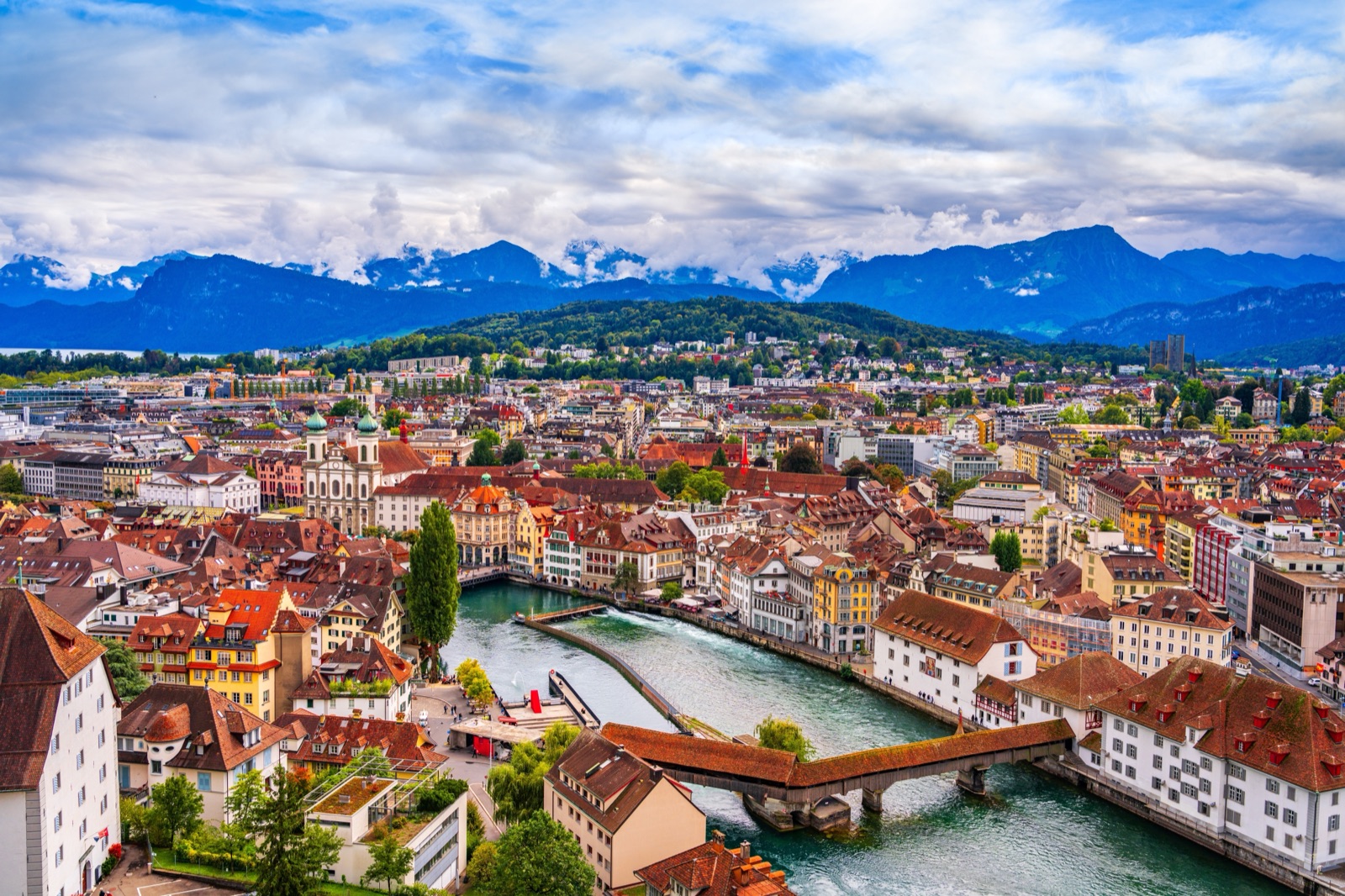
Lucerne sits where the river Reuss leaves the lake, and its old town grew up on both banks. You can see the main sights on foot in a morning, which leaves the afternoon for the water.
The Chapel Bridge and the Water Tower
The Chapel Bridge is the city’s landmark: a covered wooden footbridge over the Reuss, with the octagonal Water Tower standing in the river beside it. According to the bridges’ own website, it was probably built around 1360 and is first mentioned in 1367. You will see an earlier date quoted in many places, but the bridge website’s timeline starts at about 1360.
It is 205 metres long today, against 279 metres originally, which makes it the second-longest covered wooden bridge in Europe after the one at Bad Säckingen in Germany. Crossing is free, the bridge is open 24 hours a day, and it is wheelchair-accessible.
Look up as you walk. The triangular paintings in the roof gables were created around 1614 to 1624 and show scenes from Swiss history and the city’s patron saints. There were originally 158 of them; 62 remain on the bridge, some still partly burned. On the night of 18 August 1993 a fire destroyed a major part of the bridge. It was rebuilt in a record eight months and reopened on 14 April 1994, so much of the timber you walk on is new, while the two bridgeheads and the Water Tower survived.
The Water Tower is older than the bridge, built around 1290–1300. It is 34.5 metres high and 39 metres round, and over the centuries it served as a lookout, an archive, a treasury and, until the late eighteenth century, a prison. It is not open to the public, so enjoy it from the riverbanks, which is also where the classic photograph is taken.
The Chaff Bridge and the old squares
Walk downstream to the Chaff Bridge (Spreuerbrücke), the Chapel Bridge’s younger and smaller sibling. It dates from around 1408, is 81 metres long and has its own cycle of gable paintings on the theme of the Dance of Death, plus a small chapel. It is usually far quieter than its famous neighbour.
Between the two bridges, the old town’s squares are worth a slow loop: the Weinmarkt, the Mühlenplatz, the Hirschenplatz and the Kapellplatz, with painted house fronts and cafés along the river.
The Lion Monument
A short walk from the old town, the Lion Monument is carved into a rocky grotto in a small park. The ten-by-six-metre dying lion honours the Swiss Guards killed at the storming of the Tuileries in Paris in 1792, when the guards were defending King Louis XVI. It was designed by the Danish sculptor Bertel Thorvaldsen and inaugurated in 1821. Around 1.4 million people visit it every year, so come early or late in the day if you want a quiet moment.
The Musegg Wall
The Musegg Wall runs along the ridge above the old town and is one of the best free viewpoints in Lucerne. Luzern Tourismus gives its length as 800 metres and dates it to around 1400, after the Battle of Sempach; Switzerland Tourism gives 870 metres. Either way it is one of the longest and best-preserved town walls in Switzerland, and nine towers still stand on it.
Four of the towers are freely accessible: the Männli, the Zyt, the Watchtower and the Schirmer. The one not to miss is the Zyt Tower, built in 1442 and 31 metres tall. It holds the oldest tower clock in central Switzerland, which by tradition strikes the full hour one minute before all the other clocks in the city; be at the top just before the hour to hear it. Allow 30–45 minutes to walk the battlements, which are narrow and have steep stairs.
The wall and towers take a winter break from the beginning of November to the end of March, so this is a spring-to-autumn sight. Check the opening times before you go.
The Swiss Museum of Transport
On the lakeshore east of the centre, the Swiss Museum of Transport (Verkehrshaus) opened in 1959 and is now the most-visited museum in Switzerland. It covers road, rail, water, air and space travel, with more than 3,000 objects, simulators and interactive exhibits over some 20,000 square metres, and many of the trains, boats and aircraft can be boarded. There is also a planetarium with an 18-metre dome and a chocolate exhibition.
It is open 365 days a year. Museum hours are 10am to 6pm in summer time and 10am to 5pm in winter time, which begins on 25 October 2026. It is the obvious plan for a wet day, and families can easily fill most of one. If you want to see several museums, the Lucerne Museum Pass gives entry to ten museums on two consecutive days for CHF 39; check which ones it covers before you buy.
To get there, take bus 6, 8 or 24 from the station to Verkehrshaus - Würzenbach. The main city lido is right next door.
Swimming in the lake
On a hot day, the lake itself is one of the best things to do in Lucerne. The tourist board names three spots as especially popular.
- Lido Luzern, directly next to the transport museum, has a 300-metre sandy beach with views of Pilatus, the Bürgenstock and the Stanserhorn, shady lawns and a heated 25-metre pool for days when the lake is cool. Opening depends on the weather; on doubtful days the lido posts an update on its website in the morning.
- Seebad Luzern is on the Nationalquai, along the city’s lakefront.
- Ufschötti is the place to swim for free: a public park with an almost 200-metre sandy beach, a kiosk and space for barbecues, a few minutes’ walk from the main station. The bathing areas are open 8am to 10pm in summer, and the park is closed from the beginning of November until Easter.
Round the lake, there are lidos in many of the villages, including Beckenried and the Hopfräben lido in Brunnen. Overnight guests in Weggis receive the local visitor card, which includes free admission to the lido there.
The lake villages by boat
The scheduled boats turn the villages into easy day trips, and the ride is half the pleasure. Approximate sailing times from Lucerne, from the regional tourist board, are Weggis 45 minutes, Vitznau 55 minutes, Beckenried 1 hour 15 minutes, Brunnen 2 hours 10 minutes and Flüelen 2 hours 45 minutes. Our guide to boats, tickets and passes covers where to buy tickets and which passes are valid.
Weggis lies at the foot of the Rigi and is the classic lakeside resort. Walk the waterfront promenade towards Vitznau, where there is a memorial stone for Mark Twain, who lived in Weggis for a time. A cable car climbs from the village to the mineral baths at Rigi Kaltbad.
Vitznau is the base of the Vitznau–Rigi Kulm rack railway, which the Rigi operator calls the first mountain railway in Europe; it reaches Rigi Kulm in about 30 minutes.
Beckenried, on the southern shore, faces Rigi across the water and has its own lido.
Brunnen has a lakeside promenade that Switzerland Tourism rates among the most beautiful in the country, a Victorinox store, and views straight into Lake Uri. It is also close to the Axenstrasse, the former route for north–south traffic along Lake Uri. Above Brunnen is Stoos, reached by the world’s steepest funicular from Schwyz or by cable car from Morschach; see our article on the Stoos ridge.
Flüelen is the end of the line. At the southern tip of Lake Uri the valley opens out at the Reuss delta, and trains continue south; the Gotthard Panorama Express combines nearly three hours on the boat with the historic Gotthard line to Ticino.
Lake Uri: the Rütli, Tell’s Chapel and the Swiss Path
Beyond Brunnen, the lake turns south into Lake Uri, its most dramatic arm. Between Brunnen and Flüelen the shores rise steeply out of the water in what the lake’s shipping company describes as a fjord-like landscape. If you do not have time to sail from Lucerne, the classic Lake Uri round trip from Brunnen to Flüelen and back takes around 90 minutes.
At the entrance to Lake Uri you pass the Schillerstein, a natural obelisk rising from the water. It was originally 40 metres high, but it was cut down by a third after falling rocks endangered passing steamboats.
The Rütli meadow
The Rütli is a green meadow above Lake Uri. According to tradition, it was here that representatives of Uri, Schwyz and Unterwalden swore the oath that founded the Swiss Confederation, and 1 August 1291 is now celebrated as the Swiss National Day. Below the Rütlihaus restaurant is the oath square, where a limestone rock from Schwyz with three springs stands for the three original cantons. The point of coming is the place and the view rather than any monument.
To protect it from development, the meadow was bought in 1859 with the help of schoolchildren and donated to the federal government. It is car-free, so you arrive by boat or on foot. The easiest way is by boat from Brunnen or Flüelen, stepping off at a wooden boat station hall built in 1913. There are paths up to Seelisberg, but Switzerland Tourism warns that they are very steep.
Tell’s Chapel
Across the water, at the Tellsplatte near Sisikon, stands Tell’s Chapel, marking the spot where, in the legend, William Tell leapt from his captors’ boat. A chapel was first built here in 1388. The present one dates from 1879/80 and is decorated with four frescoes by the Basel painter Ernst Stückelberg: the Rütli oath, the apple shot, Tell’s leap and Gessler’s death.
You can reach it by boat, or drive to the Hotel Restaurant Tellsplatte, from where a steep path leads down to the chapel.
The Swiss Path
The Swiss Path (Weg der Schweiz) is a themed hiking trail that begins on the Rütli meadow and ends in Brunnen, passing Tell’s Chapel and the old Axenstrasse. Switzerland Tourism gives its length as 35 kilometres on one page and 34 km on another. It is divided into stages, so you can spend nights along the way, or hike a single stage and see the rest from a boat.
Up a mountain
The mountains that rise straight from the shore are the other half of any Lake Lucerne trip. The main choices:
- Rigi (1,798 m). The boat to Vitznau and the rack railway to Rigi Kulm in about 30 minutes; a broad, open summit with the lake spread below.
- Pilatus (2,132 m). The famous loop from Lucerne takes about 4.5 hours: up by bus and panorama gondola, down the world’s steepest cogwheel railway to Alpnachstad, and back by boat. The cogwheel railway runs from May to November.
- The Bürgenstock (1,128 m). The easiest outing: a catamaran across the lake, a funicular to the resort and the Hammetschwand lift, the highest free-standing outdoor lift in Europe.
- The Stanserhorn (1,851 m). A quieter summit, reached from Stans.
- Stoos. The world’s steepest funicular from Schwyz and a ridge walk high above Lake Uri; see Stoos ridge.
- Titlis. A glacier, a glacier cave and Europe’s highest suspension bridge around the 3,020 m top station above Engelberg, which is 43 minutes by train from Lucerne and not on the lake itself; see Mount Titlis.
Our guide to Pilatus or Rigi compares the two classic round trips in detail.
Short cruises from Lucerne
If you only have an hour or two, a cruise from the city piers is the simplest way onto the water:
- The round-trip catamaran cruise, about an hour on a modern hybrid catamaran with Rigi and the Bürgenstock in view.
- The first-class cruise with a three-course lunch, about 2 hours to Vitznau or Küssnacht and back.
- The Bürgenstock by boat and funicular, a flexible day ticket that combines the catamaran crossing with the funicular and the Hammetschwand lift.
These and other options are on the tours page. For longer lake days, see our guide to planning a day on Lake Lucerne.
Seasons: what is open when
- All year: the scheduled boats, the Chapel Bridge, the Lion Monument and the Swiss Museum of Transport (open 365 days a year).
- April to October: the Musegg Wall and its towers, which close from the beginning of November to the end of March.
- May to November: the Pilatus cogwheel railway, and with it the classic Pilatus round trip.
- Summer: the lidos, which depend on the weather; Ufschötti closes from the beginning of November until Easter.
If the weather turns, the transport museum and a covered cruise are the best fallbacks, and the mountains can wait for a clearer day.
Two sample days
A city-and-lake day. Morning in the old town: the Chapel Bridge, the Chaff Bridge and the squares, then the Lion Monument and the Musegg Wall. After lunch, a one-hour cruise from the city piers, or the boat to Weggis (about 45 minutes) for a walk along the promenade and back in the evening light.
A Lake Uri day. Take the boat from Lucerne to Brunnen (about 2 hours 10 minutes) or the train, then a boat past the Schillerstein to the Rütli. Walk up to the meadow, then continue by boat to Tell’s Chapel and on to Flüelen, returning by train or boat. Check the connecting boats on the timetable before you set off, especially outside the summer season.
Frequently asked questions
What is the most famous thing to do in Lucerne?
Crossing the Chapel Bridge, the covered wooden bridge with the Water Tower beside it. It is free, open 24 hours a day, and at 205 metres it is the second-longest covered wooden bridge in Europe.
Can you swim in Lake Lucerne?
Yes. In Lucerne itself, Lido Luzern has a 300-metre sandy beach and a heated pool, Seebad Luzern is on the lakefront, and Ufschötti park is free. Many lake villages, including Weggis, Beckenried and Brunnen, have lidos too.
How do you get to the Rütli?
By boat from Brunnen or Flüelen, which Switzerland Tourism calls the easiest way. The meadow is car-free; the footpaths up to Seelisberg are very steep.
Is the Musegg Wall open all year?
No. The wall and its towers close for the winter from the beginning of November to the end of March. From spring to autumn, four towers are open, including the Zyt Tower with its clock.
What can you do in Lucerne when it rains?
Go to the Swiss Museum of Transport, which is open 365 days a year and can fill most of a day, or take a cruise with an indoor restaurant. Save the mountains for a clear day.
Which lake village is best for a half-day trip?
Weggis (about 45 minutes by boat) for a lakeside promenade, or Vitznau (about 55 minutes) if you want to add the rack railway up Rigi.